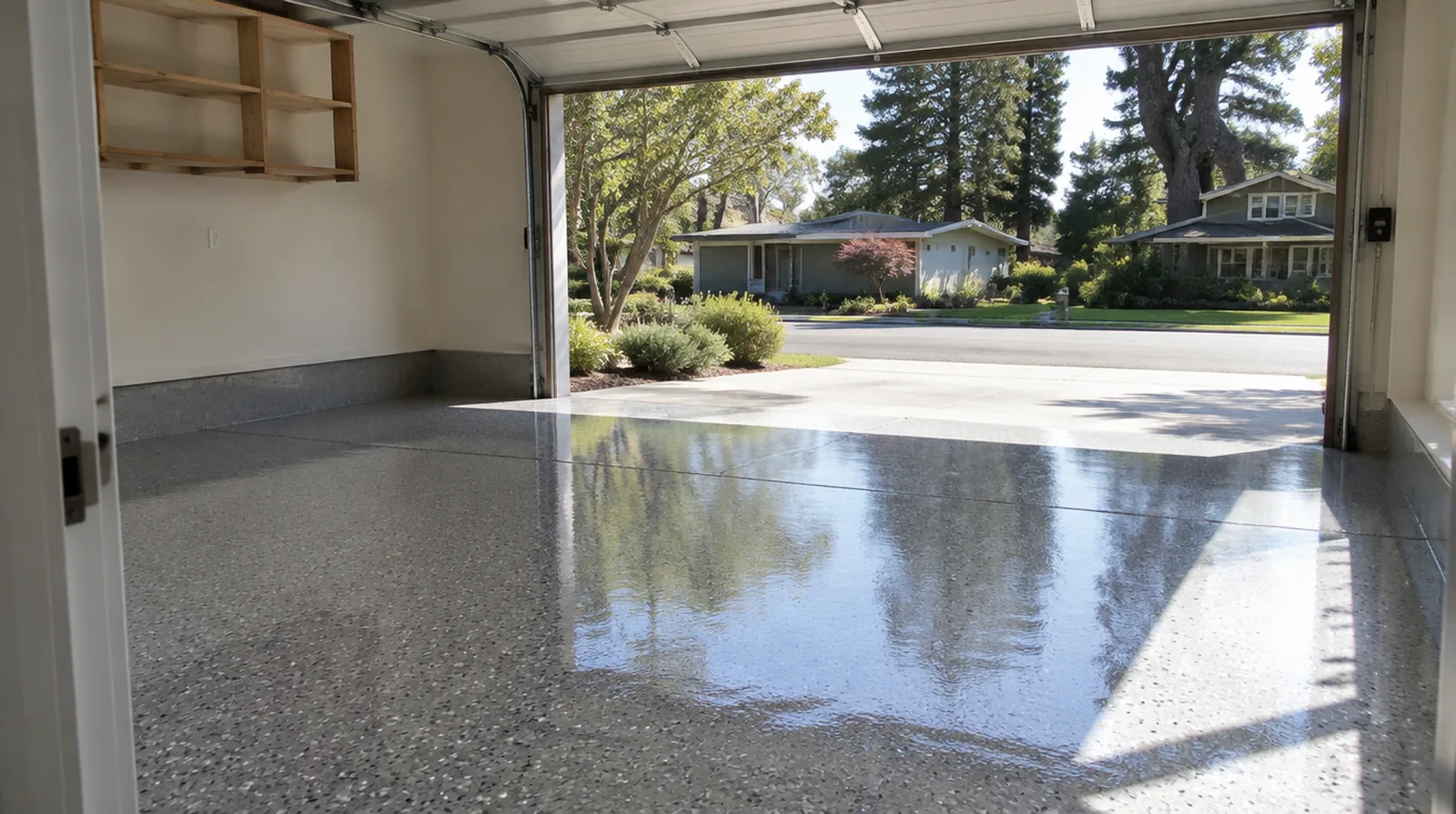
Floors for a town that thinks things through
Palo Alto homeowners tend to ask good questions before they commit to anything, and floors are no exception. What is in the coating? How does it handle moisture? Can it go over radiant heat? We like those questions, because the answers decide whether a floor lasts.
The short version: we grind every slab, test it for moisture, choose low-odor and low-VOC materials where we can, and explain the tradeoffs in plain language.
Eichlers and other slab-on-grade homes
Palo Alto has one of the largest collections of Joseph Eichler homes anywhere, from Greenmeadow and Charleston Meadows to Fairmeadow and the Midtown tracts. Those houses sit directly on concrete slabs, many with radiant heating tubes cast inside. That changes how we work: we grind lightly and carefully, avoid drilling or deep cuts, and often recommend polished concrete or a thin polyaspartic system for interior floors.
Everything we offer
- Garage epoxy for attached garages and carports
- Decorative flake for garages and utility rooms
- Metallic resin for studios, home offices and showrooms
- Commercial and lab floors for the R&D buildings near East Bayshore and the Stanford Research Park
- Coating repair and concrete sealing for patios, walks and driveways
- Epoxy countertops for kitchens, ADUs and break rooms
- Driveway coatings for worn or stained concrete driveways
- Pool deck coating with Peninsula traction and HOA-friendly colors
- Patio coating for Eichler courtyards and backyard slabs
Climate and concrete here
Summers are mild and dry, and winters bring most of the year's rain. Neighborhoods near the baylands sit over a high water table, and some slabs stay damp from below even in August. A moisture test is part of every estimate we do, because it decides which primer we use.
Can you coat over radiant heat?
Yes, with care. We keep grinding shallow and pick a coating that handles gentle warmth.
Do your products smell?
Some do while curing. We offer low-odor options and plan ventilation.
Do you work on historic homes?
Yes. We respect original materials and talk through what can and cannot change.
Neighborhoods we work in
Professorville and Old Palo Alto, Crescent Park near San Francisquito Creek, Midtown, Barron Park, Charleston Meadows and the Eichler tracts in Greenmeadow and Fairmeadow all have their own slab histories. We tailor epoxy flooring in Palo Alto to each one, from century-old garages to radiant-heated mid-century slabs.
When the garage becomes a studio
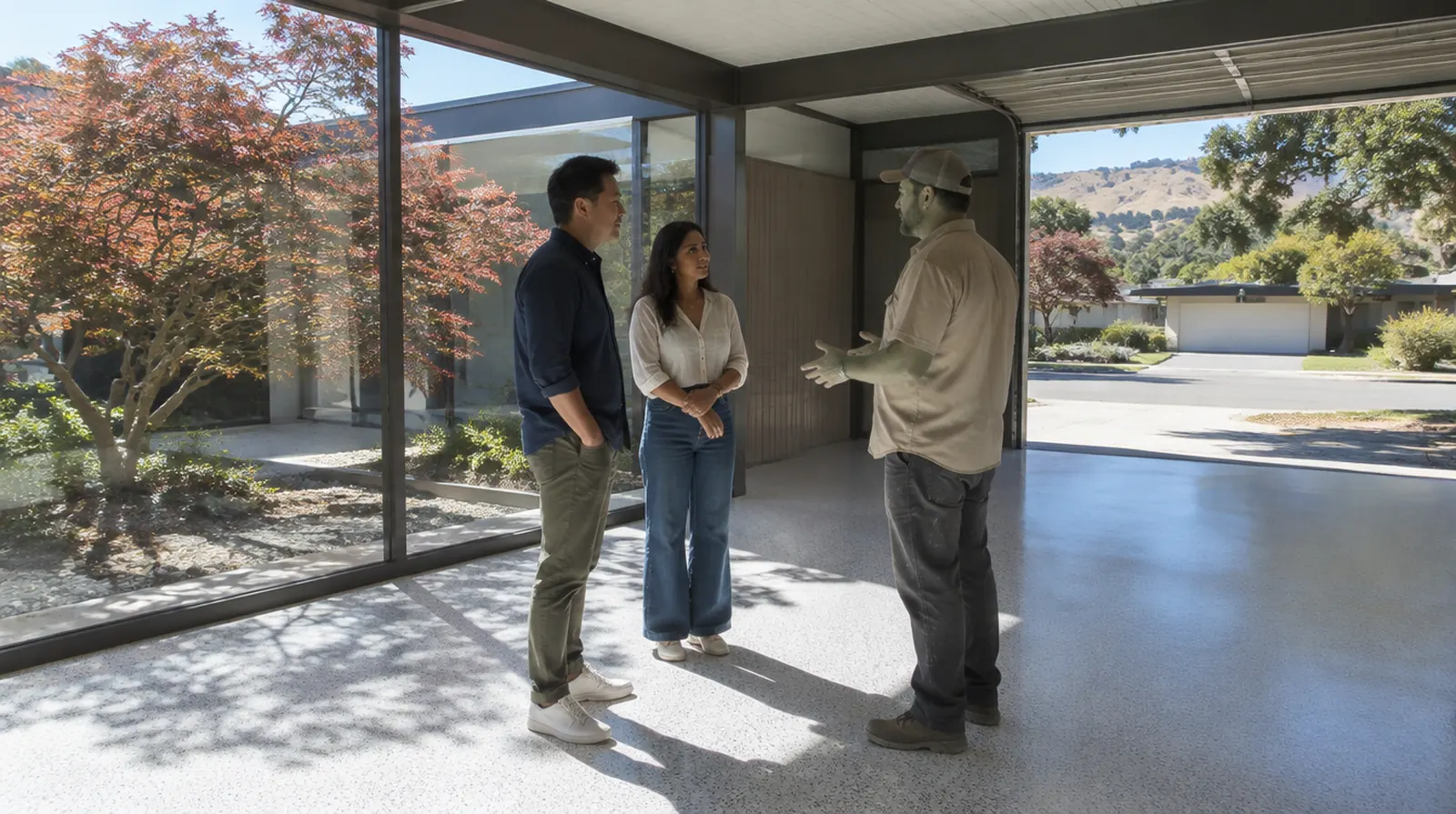
Plenty of Palo Alto garages never see a car. They become a pottery studio, a music room, a place to build robots with the kids or a quiet office away from the main house. In the Eichler tracts, that often means a garage opened up to the atrium with glass on one side. The floor in the photo is a light gray fine-flake finish that keeps the room bright and hides the dust a working studio produces. Homeowners usually want something that looks finished enough to sit comfortably next to the rest of the house, yet still shrugs off a dropped tool or a spilled can of paint.
We talk through how the space will actually be used before suggesting a system. A woodshop needs a different top coat than a yoga room, and a studio that might turn back into a garage someday needs something that can take tires later.
What happens during a site visit
Our visit is mostly about the concrete. We look at the finish, check for old sealers, adhesive or paint, and map cracks and settlement. We take a moisture reading, because slabs near the baylands and the creeks can carry more water than you might expect in a dry climate. In mid-century homes we ask about radiant heat, since tubing in the slab limits how deep we can grind and rules out anchoring anything into the floor. Then we put together a written proposal that lists every step, the products we plan to use and how many days the room will be off limits.
Older homes north of Oregon Expressway
Professorville, Crescent Park and Old Palo Alto have Craftsman bungalows, brown-shingle houses and Spanish revival homes, many with small detached garages at the back of the lot. Those garages are often older than the houses' kitchens, with thin slabs, hand-finished surfaces and decades of patches. Some have settled toward the alley or the driveway. We grind them flat where possible, fill voids and make sure any coating we add does not trap moisture against the old concrete.
Remodels, ADUs and new construction
A lot of local work happens during larger projects. New ADUs in backyards, garage conversions and full rebuilds on older lots all create fresh slabs that need a finished surface. Fresh concrete needs time to cure before it can be coated, so we coordinate with general contractors on timing and can polish or seal new slabs as soon as they are ready. If you are early in a project, it helps to call us before the concrete is poured so the finish suits what you want on top.
Low-odor work in occupied homes
Most people are living at home while we work. We seal off doorways, use dust-controlled grinders with HEPA vacuums and choose low-odor products where they make sense. On the day of the main coat, we explain how long the smell lasts and how to ventilate. Families with small children, pets or people who are sensitive to smells sometimes plan to be out for that part of the day.
Dry season and rainy season
The long dry months from late spring into fall are the easiest time to coat garages and outdoor concrete. Winter rains bring higher moisture in the ground and more humidity in the air, which slows curing. We still work through the wet season, but we watch the forecast closely and choose primers that handle damp slabs.
More questions we hear in Palo Alto
Can you coat a floor that has EV chargers and battery equipment?
Yes. We coat around mounted equipment and leave clean edges at the wall.
Do you coordinate with our contractor on a remodel?
Yes. We schedule around other trades so the floor goes in at the right point in the project.
Talk through your floor with us
Call (650) 407-2065 to book a site visit in Palo Alto.